
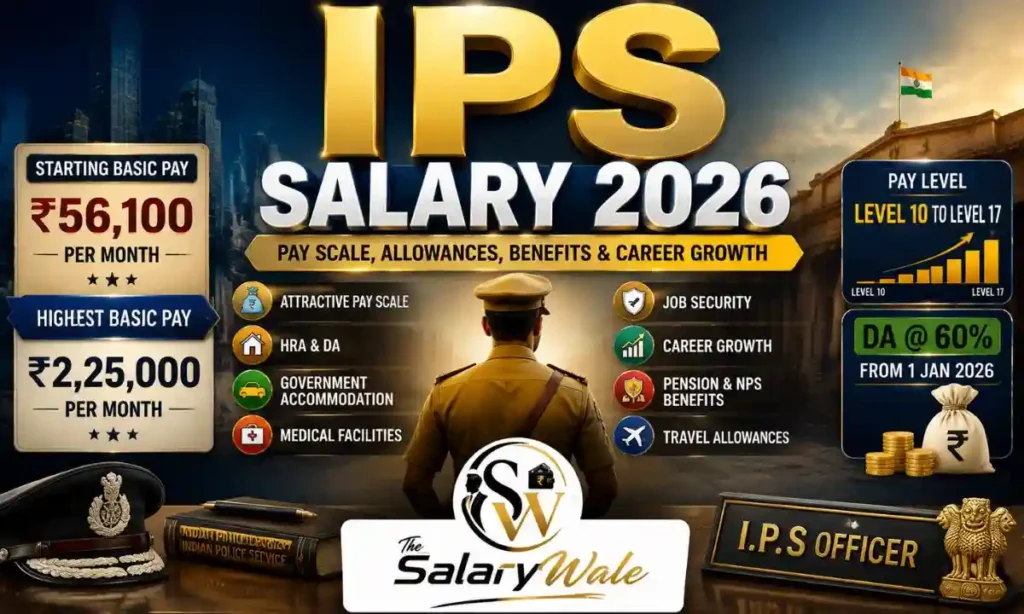
The IPS Salary 2026 is the one of the main attractors of candidates preparing for the UPSC Civil Services Examination. The Indian Police Service (IPS) is an All India Service and has a structured salary under the 7th Central Pay Commission pay matrix along with relevant allowances and other government benefits.
A junior officer in the IPS Salary 2026 enters the service in the Junior Scale, Pay Level 10 with ₹56,100 per month basic pay. With experience, progression, and promotion to higher grades and posts, the basic pay increases in the pay matrix up to ₹2,25,000 per month at the Apex Scale.
It is worth understanding that the basic pay and in-hand salary of the IPS officer are different concepts. Dearness Allowance, House Rent Allowance, Transport Allowance, and other applicable allowances add to the basic pay, while the National Pension Scheme, Income Tax, and other applicable deductions are subtracted from it. Find out more about the current IPS salary 2026 in India, starting basic pay ₹56,100, in-hand salary, pay scale depending on the rank, Dearness Allowance, House Rent Allowance, allowances, deductions, perks, training, promotion and the highest IPS salary.
IPS Salary 2026 at a Glance
The table below shows a brief overview of the IPS pay structure currently in force.
| Particular | Details |
| Full Form | Indian Police Service |
| Entry Pay Level | Level 10 |
| Starting Basic Pay | ₹56,100 per month |
| Entry Pay Scale | ₹56,100–₹1,77,500 |
| Highest Basic Pay | ₹2,25,000 per month |
| Highest Pay Level | Level 17 (Apex Scale) |
| Pay Commission | 7th Central Pay Commission |
| Dearness Allowance (DA) | 60% of Basic Pay from 1 January 2026 |
| HRA | 30%, 20%, 10% (Based on X, Y, Z Class Cities) |
| Uniform Allowance | Initial Kit Allowance + Annual Maintenance |
| In-Hand Salary | Depends on allowances, posting, accommodation and deductions |
| Recruitment | UPSC Civil Services Examination (and state promotions) |
| Training Academy | Sardar Vallabhbhai Patel National Police Academy (SVPNPA), Hyderabad |
The Department of Expenditure raised the Dearness Allowance for the Central Government employees to 60% of basic pay effective from January 1, 2026.
IPS Starting Salary 2026
The starting basic pay of the officer joining the IPS is ₹56,100 per month under Pay Level 10, and the Level 10 pay matrix goes up to ₹1,77,500.
The amount ₹56,100 is just the starting basic pay of the officer. This is not his final monthly income.
| Salary Component | Starting Position |
| Basic Pay | ₹56,100 |
| DA at 60% | ₹33,660 |
| Basic + DA | ₹89,760 |
| HRA | Depends on eligibility/posting (10% to 30%) |
| Transport Allowance (TPTA) | ₹7,200 + DA (Higher TPTA Cities) / ₹3,600 + DA (Other Cities) |
| Kit / Dress Allowance | Monthly / Annual Maintenance Grant |
| Deductions | NPS (10% of Basic + DA), Income Tax, Professional Tax |
| Final In-Hand Salary | Varies (Approx. ₹85,000 – ₹1,05,000 depending on location) |
The DA calculation uses the current 60% rate effective from January 1, 2026.
IPS Basic Pay 2026
The basic pay is the fixed component of the salary on which various other components of the salary are calculated. The starting basic pay for a newly appointed IPS officer is ₹56,100 under Level 10.
The basic pay increases with the progression of the officer through the service levels and pay grades.
| Pay Level | Basic Pay Range / Starting Basic |
| Level 10 | ₹56,100 – ₹1,77,500 |
| Level 11 | ₹67,700 – ₹2,08,700 |
| Level 12 | ₹78,800 – ₹2,09,200 |
| Level 13 | ₹1,23,100 – ₹2,15,900 |
| Level 13A | ₹1,31,100 – ₹2,16,600 |
| Level 14 | ₹1,44,200 – ₹2,18,200 |
| Level 15 | ₹1,82,200 – ₹2,24,100 |
| Level 16 | ₹2,05,400 – ₹2,24,400 |
| Level 17 | ₹2,25,000 (Fixed) |
The exact pay grade, designation and pay progression depend on the progression of the officer and the IPS pay rules. According to the official government data, the Level 10 starting point is ₹56,100 and Apex Level 17 is ₹2,25,000.
IPS Salary Rank Wise 2026
IPS officers don’t receive the same salary for the whole service career. The salary of the officer changes according to his progression through different grades and posts. Additionally, the designations differ depending on whether it is State District Policing (SP/SSP) or Police Commissionerate Systems (DCP/CP).
A detailed rank, designation, and pay-level view is given below:
| IPS Rank / Grade | Common Designations (District / Commissionerate) | Pay Level | Basic Pay |
| Entry / Jr. Scale | ASP (Assistant Superintendent of Police) / AC (Assistant Commissioner) | Level 10 | ₹56,100 |
| Senior Time Scale | Additional SP / Additional DCP | Level 11 | ₹67,700 |
| Junior Administrative Grade | SP (Superintendent of Police) / DCP (Deputy Commissioner) | Level 12 | ₹78,800 |
| Selection Grade | SSP (Senior SP) / DCP (Selection Grade) | Level 13 | ₹1,23,100 |
| DIG Grade | DIG (Deputy Inspector General) / Additional CP | Level 13A | ₹1,31,100 |
| IG Grade | IG (Inspector General) / Joint CP | Level 14 | ₹1,44,200 |
| ADG Grade | ADG (Additional Director General) / Special CP | Level 15 | ₹1,82,200 |
| Higher Administrative Grade | HAG+ Scale / Senior ADG / Director | Level 16 | ₹2,05,400 |
| Apex Scale / DGP Level | Director General of Police (DGP) / Director IB / Director CBI | Level 17 | ₹2,25,000 |
The rank and designation attached to the officer position can differ between state cadre and central postings. Rank cannot be taken for granted as the equivalent to pay grade in every posting.
IPS In-Hand Salary 2026
The IPS in-hand salary is the salary remaining after deductions from the gross income of the officer.
It cannot be claimed that there is one fixed in-hand salary for every IPS officer, because it depends on:
- Basic pay
- Dearness Allowance (DA)
- HRA eligibility (or official quarter deduction)
- Transport Allowance (TPTA) based on city class
- Posting location & Special Allowances (e.g., Hardship, SPG, IB/RAW allowances)
- Government accommodation recovery
- National Pension System (NPS) contribution
- Income tax (TDS) & Professional tax
- Other authorised deductions
For a new officer, the basic pay is ₹56,100, and the current DA is 60%. Thus, the total Basic + DA comes to ₹89,760 before other components and deductions.
| Calculation Step | Amount / Status |
| Basic Pay | ₹56,100 |
| DA @ 60% | ₹33,660 |
| Basic + DA | ₹89,760 |
| HRA (If applicable) | 10% (Z-City: ₹5,610) / 20% (Y-City: ₹11,220) / 30% (X-City: ₹16,830) |
| Transport Allowance (TPTA) | ₹7,200 + 60% DA = ₹11,520 (High TPTA) OR ₹3,600 + 60% DA = ₹5,760 (Other) |
| Gross Salary (Approx.) | ₹1,01,130 to ₹1,18,110 (depending on location) |
| NPS Deduction (10% of Basic+DA) | -₹8,976 |
| Income Tax (TDS) & Misc. | Variable |
| Final In-Hand Salary Range | Approx. ₹85,000 – ₹1,02,000 per month |
Thus, you shouldn’t take websites stating one single in-hand salary of the officer as the ultimate source.
IPS Salary Per Month
If you search specifically for the IPS salary per month, then the main figure you need to know is the starting basic pay of ₹56,100.
With the current DA rate of 60%, the basic + DA of the new officer is ₹89,760 before other components and deductions.
| Monthly Salary Component | Entry-Level Amount |
| Basic Pay | ₹56,100 |
| DA (60%) | ₹33,660 |
| Basic + DA | ₹89,760 |
| HRA | Subject to eligibility (₹5,610 to ₹16,830) |
| Transport Allowance | Subject to location (₹5,760 to ₹11,520) |
| Deductions | NPS (-₹8,976), Taxes, Insurance |
Thus, ₹56,100 shouldn’t be considered the final monthly salary of the officer. This is his starting basic pay.
IPS Dearness Allowance (DA) 2026
Dearness Allowance is the important component of the government employees’ salary calculated to compensate for the inflation.
For Central Government employees, the DA was raised from 58% to 60% of basic pay effective from January 1, 2026.
For an entry-level IPS officer:
$$\text{Basic Pay} \times 60\% = ₹56,100 \times 0.60 = ₹33,660$$
Therefore:
$$\text{Basic Pay} + \text{DA} = ₹56,100 + ₹33,660 = ₹89,760$$
| DA Calculation Component | Amount |
| Basic Pay | ₹56,100 |
| DA Rate | 60% |
| DA Amount | ₹33,660 |
| Basic + DA Total | ₹89,760 |
The DA rate can be changed in the future by government order (usually biannually in January and July). Thus, the salary articles need to be updated with every DA revision.
IPS House Rent Allowance (HRA)
House Rent Allowance is provided to assist the officer with housing issues.
The HRA amount depends on the type of the place of posting and the eligibility of the officer.
According to the 7th Central Pay Commission HRA framework, HRA increases when the DA threshold is crossed. At 60% DA, the current active HRA rates are 30%, 20% and 10% for the X, Y and Z-class cities correspondingly.
As for the IPS officers, the government accommodation can be provided depending on the post, cadre and availability of the government accommodation. Thus, the IPS officer living in government accommodation doesn’t receive the HRA in cash and pays a nominal License Fee (accommodation recovery).
| City Classification | HRA Rate (% of Basic Pay) | Example Cities |
| X Class (Metros) | 30% | Delhi, Mumbai, Kolkata, Bengaluru, Hyderabad, Chennai, Pune, Ahmedabad |
| Y Class (Tier-2) | 20% | Jaipur, Lucknow, Patna, Chandigarh, Bhopal, Visakhapatnam, etc. |
| Z Class (Rural/Tier-3) | 10% | Other towns, rural districts, and small field postings |
IPS Salary Example With HRA
In order to explain the calculation, let’s consider an example where an eligible Level 10 IPS officer receives the HRA of 30% of the basic pay (X-class city posting) and he is not drawing government accommodation.
| Component | Illustrative Amount |
| Basic Pay | ₹56,100 |
| DA @ 60% | ₹33,660 |
| HRA @ 30% of Basic | ₹16,830 |
| Transport Allowance (High TPTA City) | ₹11,520 (₹7,200 + 60% DA) |
| Gross Salary | ₹1,18,110 |
| Less: NPS Contribution (10% of Basic+DA) | -₹8,976 |
| Less: Estimated Income Tax (TDS) | -₹7,000 (Approx.) |
| Estimated Net In-Hand Salary | ₹1,02,134 |
This ₹1,02,134 is the illustrative HRA amount before other salary components and deductions. It shouldn’t be presented as the guaranteed in-hand salary of the new IPS officer. The actual salary of the officer can differ due to government accommodation, posting, applicable allowances and individual tax declarations.
IPS Transport Allowance and Other Allowances
Beside basic pay, DA and HRA, the IPS officer receives special allowances designed for the military and police service.
1. Transport Allowance (TPTA) Math
The Transport Allowance is paid to the officer to compensate for his commuting costs from residence to the office location.
- Higher TPTA Cities: Base rate of ₹7,200 + DA. At 60% DA, this equals ₹7,200 + ₹4,320 = ₹11,520 per month.
- Other Places: Base rate of ₹3,600 + DA. At 60% DA, this equals ₹3,600 + ₹2,160 = ₹5,760 per month.
2. Uniform & Kit Maintenance Allowance
Unlike the civilian service like IAS, IPS officers are dressed in the uniform.
- Initial Kit Outfit Allowance: Paid upon joining/probation (around ₹20,000 initial grant).
- Dress / Kit Maintenance Allowance (KMA): A recurring annual or monthly allowance paid to maintain uniforms and operational gear.
3. Special Security Allowance (SSA) & Deputation Perks
- SPG, IB & RAW Postings: IPS officers deputed to specialized central security agencies like the Special Protection Group (SPG), Intelligence Bureau (IB), or Research and Analysis Wing (R&AW) receive a Special Security Allowance (SSA) ranging between 20% to 25% of their Basic Pay.
- Central Deputation Allowance (CDA): Officers on central deputation receive an additional 6% to 10% of basic pay subject to prescribed caps.
- Hardship & Field Allowances: Posted in Naxal-affected zones, North-East regions, or high-altitude areas fetch additional specialized risk/hardship allowances.
| Benefit / Allowance | Dependent On / Purpose |
| Transport Allowance (TPTA) | Applicable city class rules (Higher TPTA vs Other) |
| Kit Maintenance / Dress Allowance | Standard uniformed service entitlement |
| Travelling Allowance (TA/TTA) | Official travel and transfer duty luggage/travel reimbursement |
| Special Security Allowance (SSA) | Postings in SPG, IB, R&AW (20% to 25% extra basic pay) |
| Central Deputation Allowance | Postings in Central Agencies / CAPFs (BSF, CRPF, CISF) |
| Medical Benefits | Central Government Health Scheme (CGHS) / State Medical Rules |
| Government Residence | Post, cadre, and availability of official police quarters |
It should be noted that it is important to distinguish the cash salary from government facilities. The official residence, orderly assistance or duty vehicle is not the same thing as cash payment in the bank account.
IPS Salary Deductions
The gross income of the IPS officer is deducted by various allowances before crediting the final amount to his bank account.
Common deductions include:
- National Pension System (NPS) employee contribution
- Income Tax / Tax Deducted at Source (TDS)
- Professional Tax (State-specific, usually ₹200/month)
- Central Government Employees Group Insurance Scheme (CGEGIS)
- License fee / Water & Electricity charges for government accommodation
- Loan or advance recoveries (if drawn)
| Deduction | Effect & Calculation Rules |
| NPS Contribution | Mandatory deduction of 10% of (Basic Pay + DA) |
| Income Tax (TDS) | Based on the officer’s chosen tax regime (New vs Old) and overall taxable income |
| Insurance / CGEGIS | Fixed standard monthly deduction for group insurance coverage |
| Accommodation Recovery | Nominal license fee deducted if official residence is allotted |
| Loan / Advance Recovery | Applies if computer, motor car, or personal advances have been taken |
IPS NPS Contribution
The IPS officers appointed after January 1, 2004, are enrolled in the National Pension System (NPS).
The NPS deduction structure works as follows:
- Employee Contribution: Mandatory 10% of (Basic Pay + DA) deducted from the monthly salary.
- Calculation at Entry Level: $10\% \text{ of } ₹89,760 = ₹8,976\text{ per month}$.
- Government (Employer) Contribution: The government contributes 14% of (Basic Pay + DA) into the officer’s NPS account.
- Government Contribution at Entry Level: $14\% \text{ of } ₹89,760 = ₹12,566.40\text{ per month}$.
| NPS Aspect | Rules & Explanation |
| Purpose | Dedicated retirement corpus investment |
| Monthly Employee Contribution | 10% of (Basic Pay + DA) deducted from cash salary |
| Monthly Government Contribution | 14% of (Basic Pay + DA) deposited directly by Government |
| Tax Benefits | Tax-deductible under Tier-1 NPS rules |
| Retirement Benefit | Accumulated corpus + annuity options upon superannuation |
Thus, the government contribution increases the final pension without reducing the monthly cash salary of the officer.
IPS Salary Slip
The salary slip of the IPS officer is the detailed report of his monthly income and deductions.
It contains distinct sections:
| Salary Slip Section | Details & Components Included |
| Basic Pay | Current pay step in the pay matrix (e.g., ₹56,100) |
| Dearness Allowance (DA) | Current DA rate amount (e.g., ₹33,660 at 60%) |
| House Rent Allowance | HRA amount (if official accommodation is NOT availed) |
| Transport Allowance | Fixed TPTA + DA component based on city |
| Special / Uniform Allowances | Kit maintenance, hard area, or deputation allowances |
| Gross Earnings | Sum total of all basic pay and cash allowances |
| NPS Employee Deduction | 10% of (Basic + DA) deducted for retirement |
| Income Tax (TDS) | Monthly income tax deduction |
| Other Deductions | CGEGIS insurance, professional tax, quarter license fees |
| Net Pay (In-Hand) | Total Cash Credited = Gross Earnings − Total Deductions |
The exact format and components can differ depending on the State Treasury or Central Pay and Accounts Office (PAO) issuing the payroll.
IPS Annual Salary
The annual salary of the officer at the starting pay level is calculated as follows:
$$₹56,100 \times 12 = ₹6,73,200$$
This is annual basic pay, not the total annual CTC or gross package.
| Annual Salary Component | Amount / Status |
| Starting Monthly Basic | ₹56,100 |
| Starting Annual Basic Pay | ₹6,73,200 |
| Annual DA (at current 60% rate) | ₹4,03,920 (₹33,660 × 12) |
| Annual Basic + DA Total | ₹10,77,120 |
| Annual HRA & TPTA | Adds approx. ₹1.5 Lakh to ₹2.5 Lakh annually |
| Gross Annual Earnings (Entry) | Approx. ₹12.5 Lakh to ₹14.5 Lakh per annum |
| Annual In-Hand Package | Depends on tax regime and deductions (Approx. ₹10 to ₹12 Lakhs) |
With the current 60% DA, the annual DA on the basic salary ₹56,100 is ₹4,03,920, but the annual earnings of the officer would increase with the annual increments (3% every July/January) and DA revision twice a year.
Highest IPS Salary in India
The highest basic pay of the IPS officer is ₹2,25,000 per month at the Apex Scale – Level 17.
This scale is occupied by the senior officers who hold top leadership positions as the Director General of Police (DGP) of the state, the Director of the Intelligence Bureau (IB), Director of the CBI, or Director General of CAPFs (BSF, CRPF, CISF, ITBP).
| Highest Pay Detail | Amount / Rules |
| Pay Level | Level 17 (Apex Scale – Fixed) |
| Monthly Basic Pay | ₹2,25,000 per month |
| Annual Basic Pay | ₹27,00,000 per annum |
| Monthly DA (at 60%) | ₹1,35,000 per month |
| Basic + DA Total | ₹3,60,000 per month |
| Gross Monthly Earnings | Exceeds ₹4,00,000+ per month (including HRA & TPTA) |
| Total Compensation Package | Depends on deputation, accommodation, and official perks |
An officer doesn’t automatically get to ₹2.25 lakh after the definite years of service. It depends on his tenure, vacancy, empanelment, seniority of the state cadre and meritorious promotions.
IPS Salary After 5 Years
The salary of the IPS officer increases gradually over the years due to annual increments (3% of basic), DA raises and progression to the higher pay levels.
After 5 years of service, an IPS officer completes the probation period (Level 10) and gets promoted to Senior Time Scale (Level 11) or Junior Administrative Grade (Level 12) as Additional SP or SP / DCP in the district or city.
The Academy mid-career training framework assumes the connection between the stages of career progression and training. For example, SVPNPA indicates that Phase III training is linked with promotion from Senior Scale to Junior Administrative Grade.
| Career Factor | Effect on 5-Year Salary |
| Service Level Progression | Level 10 (₹56,100) → Level 11 (₹67,700) or Level 12 (₹78,800) |
| Basic Pay Range | Approx. ₹70,000 to ₹83,000 per month |
| Projected DA Rate | Subject to future government revisions |
| Approximate Monthly In-Hand | ₹1,05,000 – ₹1,25,000 per month (Est.) |
| Typical Designations | SP / SSP / DCP / Commandant in CAPF |
Thus, it is not correct to guarantee one fixed “in-hand salary of the IPS officer after 5 years” of service, as it depends on cadre promotion speed and the posting location.
IPS Salary After 10 Years
After 10-12 years of service, an IPS officer takes up senior executive responsibilities. He progresses through Selection Grade (Level 13) or DIG Grade (Level 13A).
The designations of the officer at this stage include Senior Superintendent of Police (SSP), Deputy Inspector General of Police (DIG) or Deputy Commissioner of Police (Selection Grade).
| Career Factor | Effect on 10-Year Salary |
| Service Level Progression | Level 13 (₹1,23,100) or Level 13A (₹1,31,100) |
| Basic Pay Range | ₹1,23,100 – ₹1,40,000+ per month |
| Basic + DA (at 60%) | Exceeds ₹1,96,000 to ₹2,20,000+ per month |
| Approximate Monthly In-Hand | ₹1,60,000 – ₹1,90,000 per month (Est.) |
| Operational Responsibilities | Large District/Range Policing, DIG of Range, Central Deputation |
The current mid-career training framework of the Academy assumes that Phase IV training is linked with promotion from DIG to IG grade.
IPS Career Growth and Promotion
IPS service offers fast career growth from the sub-divisional field police service to the high ranks of the national security leadership.
The simplified career path and promotion hierarchy is shown below:
| Career Stage / Rank | Typical Designation | Pay Level | Primary Responsibility |
| Probationer / ASP | Assistant Superintendent of Police / AC | Level 10 | Training and Sub-Divisional (SDPO) field exposure |
| SP / DCP | Superintendent of Police / Deputy Commissioner | Level 11 & 12 | District Police Leadership / City Zone Command |
| SSP / DCP (SG) | Senior Superintendent of Police | Level 13 | Major District Command / Specialized Units |
| DIG / Addl. CP | Deputy Inspector General / Addl. Commissioner | Level 13A | Police Range Supervision (Multiple Districts) |
| IG / Joint CP | Inspector General of Police / Joint Commissioner | Level 14 | Administrative Zone / Operational Wings |
| ADG / Special CP | Additional Director General of Police | Level 15 | State Bureau Chief / Central Agency Leadership |
| DGP / Director | Director General of Police / IB / CBI Chief | Level 16 & 17 | Head of State Police Force / National Agencies |
SVPNPA indicates that the basic course of the Academy prepares the IPS probationers for initial discharge of duties as Sub-Divisional Police Officers (SDPO) and further supervisory duties including those of the Superintendent of Police.
IPS Training and Salary
The newly recruited IPS officers are trained at the Sardar Vallabhbhai Patel National Police Academy (SVPNPA) in Hyderabad.
During the training period, IPS probationers receive the full basic pay of Level 10 (₹56,100) along with DA and applicable allowances (except for the mess charges and Academy deductions).
SVPNPA official information on the basic course indicates that IPS training includes both indoor and outdoor physical modules:
| Training Domain | Covered Subjects & Skill Development |
| Indoor Academics | Police Law, Criminology, Investigation Supervision, Forensics, Cybercrime, Internal Security, Ethics & Human Rights |
| Outdoor Physical Modules | Physical Fitness, Drill, Weapon Training & Firing, Unarmed Combat, Yoga, Horse Riding, Field Craft & Tactics |
| Practical Training | District Practical Training (DPT) attached to state police stations and district headquarters |
The current service standards document of the Academy defines the basic course of the newly recruited IPS probationers in phases, including Phase-I, District Practical Training, and Phase-II.
IPS Job Profile and Duties
The activities of the IPS officer extend far beyond the law enforcement. Depending on the cadre, state or central posting, his duties can include operations, administration, and intelligence tasks.
| Major Responsibility Area | Operational Description |
| Law & Order Maintenance | Preventing riots, managing public protests, maintaining public peace during major events |
| Crime Prevention & Detection | Designing policing strategies, tracking organized crime syndicates, controlling cybercrime |
| Investigation Supervision | Supervising high-profile criminal investigations, forensic analysis, and court prosecutions |
| Police Administration | Managing human resources, station budgets, logistics, and personnel discipline |
| Public Safety & VIP Security | Managing security protocols for dignitaries, public transport systems, and critical infrastructure |
| Internal Security & Anti-Terror | Handling counter-insurgency operations, Naxalite operational zones, and counter-terrorism wings |
| Crisis & Disaster Management | Leading rescue and relief operations during natural disasters and civil emergencies |
| Community Policing | Developing public outreach programs, youth engagement, and community trust initiatives |
The exact duties of the IPS officer largely depend on whether he is posted in the field police service, VIP security, intelligence agency or administration.
IPS Salary Benefits and Perks
Besides the salary, the IPS officer receives extensive government benefits and perks:
- Government Accommodation: Official rent-free residence or bungalow in VIP police lines/civil lines.
- Official Transport: Dedicated government vehicle (with beacon/siren as per rules) along with a driver for official duties.
- Security & Domestic Support: Armed orderlies, security guards at residence, and official domestic staff support based on posting and threat assessment.
- Medical Facilities: Complete healthcare coverage under CGHS or state medical reimbursement for self and dependents.
- Communication Perks: Free official mobile connections, landline, broadband, and electricity allowances as per state/central rules.
- Study Leave: Eligible for higher studies in India or abroad with full pay after completing specified years of service.
- Pension & Gratuity: Long-term social security via National Pension System (NPS) and retirement gratuity.
| Benefit | Nature & Scope |
| Government Accommodation | Non-cash service bungalow/quarter with official security |
| Duty Vehicle & Driver | Authorized transport facility for official responsibilities |
| Medical Benefits | Comprehensive healthcare cover for officer and family |
| Travel Benefits (LTC) | Leave Travel Concession for family travel within India |
| Retirement Benefits | NPS Corpus + Death-cum-Retirement Gratuity (DCRG) |
| Security Cover | Personal Security Officer (PSO) based on duty profile |
The exact benefits can differ depending on the post, cadre, place of posting and government regulations.
IPS Salary in State Police vs Central Deputation
The IPS officer is an All India Service officer and he can serve either in his state cadre or on the central deputation in Union ministries and central agencies.
The basic pay of the officer remains unchanged according to the 7th CPC IPS pay matrix, but the allowances differ according to the posting.
| Factor | State Cadre Posting | Central Deputation Posting |
| Primary Roles | District SP, Range DIG, State Law & Order, State CID | CAPFs (BSF, CRPF, CISF, ITBP), IB, CBI, RAW, SPG, MHA |
| Deputation Allowance | Standard State Allowances | Central Deputation Allowance (CDA) added (6% to 10%) |
| Special Security Perks | State Risk Allowances (if in Naxal areas) | Special Security Allowance (SSA – 20% to 25%) in IB/RAW/SPG |
| Accommodation | State Police Quarters | Central Pool Quarters (e.g., General Pool Residential Accommodation – GPRA) |
That is another reason why the in-hand salary of the IPS officer cannot be the fixed single amount for all postings.
IPS Salary vs IAS Salary
The Indian Police Service (IPS) and Indian Administrative Service (IAS) are the All India Services selected through the UPSC Civil Services Examination. Their basic pay scale is standardized under the 7th Pay Commission, but some differences in career path, allowances and duties exist.
| Feature / Aspect | IPS (Indian Police Service) | IAS (Indian Administrative Service) |
| Entry Pay Level | Level 10 | Level 10 |
| Starting Basic Pay | ₹56,100 per month | ₹56,100 per month |
| Recruitment Exam | UPSC Civil Services Exam | UPSC Civil Services Exam |
| Training Academy | SVPNPA, Hyderabad | LBSNAA, Mussoorie |
| Highest Basic Pay | ₹2,25,000 (Level 17 – DGP / IB Director) | ₹2,50,000 (Cabinet Secretary Scale) |
| Uniform Allowance | Yes (Dress / Kit Maintenance Allowance) | No (Civilian Service) |
| Key Roles | SP, DIG, IG, ADG, DGP, Intelligence, Security | SDM, DM/Collector, Divisional Commissioner, Secretary |
| Work Focus | Law & order, crime prevention, security | General administration, policy, development |
The main difference is not in the starting basic pay, but in the service environment, organizational structure and specialized allowance and the ultimate cabinet promotion levels.
IPS Salary After 8th Pay Commission
The candidates search for the IPS salary projections under the upcoming 8th Central Pay Commission.
At present, any revised IPS salary figures shouldn’t be presented as the guaranteed amount until officially announced by the Government of India.
| Question / Parameter | Official Status & Current Position |
| Current Pay Framework | 7th Central Pay Commission (7th CPC) |
| Current Entry Basic Pay | ₹56,100 per month |
| Current DA Rate (Jan 2026) | 60% of Basic Pay |
| 8th Pay Commission Status | Government framework established; fitment factor not finalized |
| Speculative Figures | Online “2.57x or 3.0x fitment projections” are unofficial estimates |
Thus, such approach helps to avoid presenting the projected figures as the official salaries.
What Is the Difference Between IPS Basic Pay and In-Hand Salary?
It is important for the candidates to understand the difference between Basic Pay, Gross Salary and In-Hand Salary.
- Basic Pay: The fixed entry-level pay matrix figure (₹56,100 at Level 10) on which allowances are calculated.
- Gross Salary: Basic Pay plus all added cash allowances (DA + HRA + Transport Allowance + Special Allowances).
- In-Hand Salary: The final amount deposited in the bank account after deducting NPS, Income Tax (TDS), and other statutory recoveries.
| Salary Classification | Entry Level Representation |
| Basic Pay | ₹56,100 |
| Gross Salary | Approx. ₹1,01,000 to ₹1,18,000 |
| In-Hand (Net) Salary | Approx. ₹85,000 to ₹1,02,000 |
Thus, the ₹56,100 starting basic pay of the IPS officer is not his in-hand salary.
Factors That Affect IPS In-Hand Salary
The amount of cash credit in the IPS officer’s account depends on a variety of dynamic factors:
- Basic Pay Step: Increases annually through 3% increments and promotional grade changes.
- DA Revisions: Revised twice a year by the Central Government based on inflation indexes.
- City Classification (X, Y, Z): Governs HRA (30%, 20%, 10%) and Transport Allowance rates.
- Government Accommodation: If an official quarter is allotted, cash HRA is forfeited and license fees are deducted.
- Deputation & Agency Allowances: Postings in SPG, IB, RAW, or CAPFs add 10% to 25% extra allowances.
- Tax Regime Choice: Old Tax Regime vs New Tax Regime choice alters monthly TDS deductions.
- NPS Deductions: Dynamic 10% deduction based on fluctuating Basic + DA totals.
Thus, the in-hand IPS salary can vary for different postings rather than being the fixed one.
IPS Salary 2026: Complete Pay Structure Summary
Here is the summary table of the IPS pay structure in 2026.
| Particular | IPS Salary 2026 Summary Details |
| Starting Basic Pay | ₹56,100 per month |
| Entry Pay Level | Level 10 (Junior Scale) |
| Entry Pay Scale | ₹56,100 – ₹1,77,500 |
| Active DA (Jan 2026) | 60% of Basic Pay |
| Entry-Level DA Amount | ₹33,660 per month |
| Basic + DA Total | ₹89,760 per month |
| Applicable HRA Rates | 30% (X City) / 20% (Y City) / 10% (Z City) |
| Transport Allowance (TPTA) | ₹11,520 (High TPTA City) / ₹5,760 (Other Cities) |
| Mandatory NPS Deduction | 10% of (Basic + DA) = ₹8,976 (Employee Side) |
| Government NPS Contribution | 14% of (Basic + DA) = ₹12,566 (Deposited by Govt) |
| Estimated Entry In-Hand | ₹85,000 – ₹1,02,000 per month |
| Maximum Basic Pay | ₹2,25,000 per month (Level 17 – Apex Scale) |
| Annual Starting Basic | ₹6,73,200 per annum |
| Annual Gross CTC (Approx.) | ₹12.5 Lakhs – ₹14.5 Lakhs per annum |
The DA rate is based on the order of the Department of Expenditure effective from January 1, 2026, while the pay levels are according to the 7th CPC IPS pay structure.
FAQs
What is the starting salary of an IPS officer in 2026?
The starting basic pay of an IPS officer is ₹56,100 per month at Pay Level 10. With 60% DA (₹33,660), HRA, and Transport Allowance, the gross entry salary ranges between ₹1,01,000 and ₹1,18,000 per month, resulting in an in-hand salary of approximately ₹85,000 to ₹1,02,000.
What is the in-hand salary of an IPS officer?
There is no single fixed in-hand salary for every IPS officer. It depends on basic pay, DA, HRA eligibility, city posting, government accommodation, transport allowances, and deductions such as NPS (10%) and income tax.
What is the highest IPS salary in India?
The highest basic pay in the current IPS pay structure is ₹2,25,000 per month at Pay Level 17 (Apex Scale), held by top officers like state DGPs, the Director of the IB, or the Director of the CBI.
What is the IPS salary per month after joining?
An IPS officer starts with ₹56,100 basic pay per month. With the 60% DA, basic plus DA comes to ₹89,760 before adding HRA/TPTA and subtracting mandatory deductions.
How much DA does an IPS officer get in 2026?
The Central Government Dearness Allowance (DA) rate stands at 60% of basic pay with effect from January 1, 2026.
Conclusion
The IPS Salary 2026 is the government compensation scheme that starts with a basic pay of ₹56,100 at Level 10 and reaches ₹2,25,000 at Level 17. The total salary package becomes very attractive considering the 60% Dearness Allowance (DA), House Rent Allowance (HRA), Transport Allowance (TPTA) and specialized perks.
For 2026, an entry level IPS officer receiving ₹56,100 basic pay gets ₹33,660 as DA, thus the total Basic + DA is ₹89,760 before accounting for city allowances and mandatory deductions.
However, the candidates shouldn’t only rely on the monetary aspects of the IPS Salary. Official accommodation, medical care, security protection, duty vehicle, retirement security through the 14% government NPS and ability to command the law enforcement units constitute the whole package of IPS. Understanding the difference between basic pay, gross earnings and in-hand salary gives a realistic view of the IPS officer’s earnings throughout the career.
Also, Read About: IBPS Clerk Salary 2026: In-Hand Salary, Basic Pay, Pay Scale, Allowances, Benefits & Career Growth