
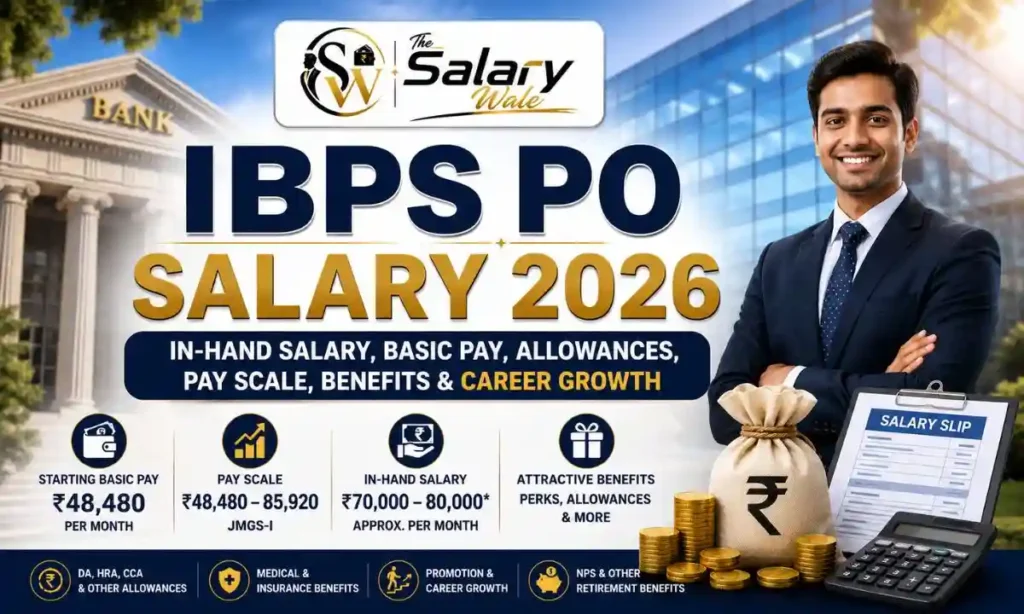
The IBPS PO Salary 2026 is amongst the most researched topics by banking aspirants due to the lucrative combination of salary, allowances, job security, promotion opportunities, and other associated benefits that an officer can reap in his career as an officer. IBPS Probationary Officer joins one of the participating public sector banks as Scale-I officer receiving fixed basic pay plus various allowances.
After making various deductions including NPS contribution, Income Tax, Professional Tax and other recoveries, whatever amount is left after all such deductions is the in-hand salary of an officer.
Further, it needs to be understood that IBPS PO salary is not Central Government 7th Pay Commission Salary. Pay of public sector bank officers is decided according to applicable banking industry settlements and service rules.
IBPS PO Salary 2026: Quick Overview
The following table gives quick overview about the salary structure of an IBPS PO including basic pay, pay scale, allowances, and in-hand salary.
| Particular | Details |
| Post | Probationary Officer / Management Trainee |
| Cadre | Officer, JMGS-I |
| Starting Basic Pay | ₹48,480 per month |
| Pay Scale | ₹48,480 – ₹2,000/7 – ₹62,480 – ₹2,340/2 – ₹67,160 – ₹2,680/7 – ₹85,920 |
| Maximum Basic Pay in Scale-I | ₹85,920 |
| Gross Salary | Approximately ₹90,000+ per month depending on posting and allowances |
| Approx. In-Hand Salary | Around ₹70,000–₹80,000, varying by city type (X, Y, Z) and deductions |
| Major Allowances | DA, HRA/Leased Accommodation, Special Allowance, Learning Allowance, CCA/Location Allowance |
| Retirement Benefits | NPS (with 14% employer contribution) and other applicable benefits |
| Career Growth | Promotion to higher officer scales |
IBPS PO Basic Pay 2026
Basic Pay of an IBPS PO is ₹48,480 per month. Basic Pay is the fixed component of the salary and forms the base of the various other components of salary.
Basic Pay is not constant during the entire career of the officer as increments are provided as per applicable pay scales.
| Pay Stage | Basic Pay |
| Starting Basic Pay | ₹48,480 |
| After 1st Increment | ₹50,480 |
| After 2nd Increment | ₹52,480 |
| After 3rd Increment | ₹54,480 |
| After 4th Increment | ₹56,480 |
| After 5th Increment | ₹58,480 |
| After 6th Increment | ₹60,480 |
| After 7th Increment | ₹62,480 |
| Later stages | Up to ₹85,920 |
| Maximum Basic Pay in Scale-I | ₹85,920 |
IBPS PO Pay Scale
At present, IBPS PO Scale-I pay scale is as follows:
₹48,480 – ₹2,000/7 – ₹62,480 – ₹2,340/2 – ₹67,160 – ₹2,680/7 – ₹85,920
In simple words, the officer starts with basic pay of ₹48,480 and receives increments as per the applicable stages of pay scale. Once ₹62,480 is reached, increment is changed and again it is changed once ₹67,160 is reached.
Maximum basic pay under this Scale-I is ₹85,920 without taking into consideration any additional allowances.
IBPS PO In-Hand Salary 2026
IBPS PO in-hand salary means the amount that is received by an officer in his bank account after adding various salary components and making various deductions such as NPS contribution, tax and other recoveries.
A single fixed in-hand salary cannot be determined for IBPS PO as the ultimate figure depends on various factors including posting location, city-wise classification, applicable allowances, various deductions, and salary rules of the bank.
For new joiners, the in-hand salary is normally between ₹70,000 to ₹80,000 per month depending upon whether the posting is metro city or rural area.
IBPS PO Monthly Salary Structure
Salary of an IBPS PO consists of various components including basic pay and various other allowances as per the applicable salary rules of the bank.
| Salary Component | Details |
| Basic Pay | ₹48,480 |
| Dearness Allowance | Based on the applicable quarterly rate |
| Special Allowance | Applicable as per banking settlement |
| HRA / Leased Accommodation | Depends on posting/location category |
| Learning Allowance | Applicable as per rules |
| CCA/Location Allowance | Depends on eligible location |
| Gross Salary | Varies according to applicable components (~₹90,000+) |
| Deductions | NPS, tax and other applicable deductions |
| In-Hand Salary | Generally around ₹70,000–₹80,000 depending on city type |
The ₹48,480 basic pay is only the starting point for the IBPS PO. Various applicable allowances are added for arriving at gross salary.
Exact salary structure can vary from officer to officer because various allowances and deductions are not the same for everyone.
IBPS PO Gross Salary 2026
Gross Salary of an IBPS PO means the total amount that is earned by the officer before making any deduction. It includes basic pay and various allowances such as DA, HRA or Leased Accommodation, Special Allowance, Learning Allowance and other location-based allowances.
According to recent calculations, gross salary of an IBPS PO can be above ₹90,000 depending upon the DA rate, posting location and other components of salary. Therefore, gross salary should be considered as a variable and not as a single fixed amount.
| Component | Approximate Position |
| Basic Pay | ₹48,480 |
| DA | Depends on current rate |
| HRA / Lease | Location dependent (Higher in metros) |
| Special Allowance | Applicable as per rules |
| Learning Allowance | Applicable |
| CCA/Location Allowance | Location dependent |
| Gross Salary | Approximately ₹90,000+ in various examples |
IBPS PO Salary Slip 2026
IBPS PO salary slip gives details about basic salary, various allowances and deduction for arriving at net salary.
For instance, salary slip can contain basic pay, DA, HRA, Special Allowance, Learning Allowance and other location-based allowances under the heads of earnings. After that, various deductions including NPS contribution and taxes are made from the total earnings for arriving at net salary.
The basic calculation can be understood as:
Basic Pay + Allowances = Gross Salary
Gross Salary − Deductions = Net/In-Hand Salary
Because DA rates and other applicable components can change, salary-slip figures published online should be treated as examples rather than a guaranteed amount for every IBPS PO.
IBPS PO Dearness Allowance (DA)
Dearness Allowance (DA) is one of the key components of the salary of IBPS PO. The DA is related to inflation and is revised periodically according to the applicable banking industry settlement.
According to the latest settlement, the DA for Bank Officers and Employees in May, June and July 2026 is 25.70%. However, the rate can change in future quarters.
| Period | DA Rate |
| May 2026 | 25.70% |
| June 2026 | 25.70% |
| July 2026 | 25.70% |
IBPS PO HRA & Leased Accommodation
HRA is provided to an IBPS PO according to the posting location and applicable pay rules. As the HRA cost varies from city to city, the salary structure is different for different postings.
Further, eligible officers can also go for Leased Accommodation according to the applicable rules of the bank in place of normal HRA. Under this arrangement, the officer gets to stay in bank-leased house/house-lets where bank directly pays the rent (which is much higher than normal HRA, especially in metro cities).
| Factor | Effect on HRA / Lease |
| Posting Location | Determines X, Y, or Z city category and rent limits |
| Basic Pay | Important for salary calculation |
| Bank Rules | Determine the applicable benefit |
| Leased Accommodation | Replaces cash HRA with direct bank-paid rent facility |
| Service Rules | Determine final entitlement |
IBPS PO Special Allowance
The special allowance is another component which forms a major part of the salary structure of an IBPS PO besides basic pay. It is calculated according to the applicable banking industry settlement and the officer scale.
In the case of a Scale-I officer with a basic pay of ₹48,480, the current salary examples indicate special allowance of around ₹12,000 to ₹13,000. The exact amount should always be determined according to the applicable salary rules.
The exact amount should always be calculated according to the current salary rules applicable at the time.
IBPS PO Learning Allowance
Learning allowance is another component which may also form a part of the salary structure of the officer.
This allowance is relatively lower than basic pay and DA but contributes to the gross salary of an IBPS PO.
IBPS PO CCA and Location Allowance
City Compensatory Allowance (CCA) or any other applicable location allowance is based on the posting location of an IBPS PO. If the officer is posted in an eligible higher location, he/she may get a higher location allowance than the one posted in some other location.
This is one of the reasons why two IBPS PO officers may get different gross and in-hand salary despite having same basic pay.
IBPS PO Salary Deductions
The gross salary is not the final amount which is credited to the officer’s bank account. Various deductions can be made from the gross salary.
| Deduction | Purpose |
| NPS Contribution | Retirement savings |
| Income Tax/TDS | Applicable tax liability |
| Professional Tax | Applicable state rules |
| Insurance | Applicable employee scheme |
| Loan/Advance Recovery | If applicable |
| Other Recoveries | As applicable under bank rules |
After making these deductions from the gross salary, the remaining amount becomes the net salary or in-hand salary of the officer.
IBPS PO NPS Contribution
An IBPS PO officer is enrolled in the National Pension Scheme (NPS). The employee contribution towards NPS is deducted from the gross salary whereas the bank (Employer) makes a substantial contribution (typically 14%) towards NPS separately according to the applicable rules.
Though this reduces the monthly credited amount, it adds up in the pension of the officer.
IBPS PO City-Wise Salary Breakdown
The posting location is directly related to the salary of an IBPS PO since the HRA/Lease, CCA and other location-based benefits vary largely in different city types.
| City Category | Examples of Cities | In-Hand Salary Impact / Estimate |
| X-City (Metros) | Mumbai, Delhi, Bengaluru, Chennai, Hyderabad, Kolkata, Ahmedabad, Pune | Highest allowances & HRA/Lease (~₹72,000 – ₹76,000+ in-hand) |
| Y-City (State Capitals/Large Cities) | Jaipur, Lucknow, Patna, Bhopal, Chandigarh, Surat, etc. | Moderate allowances (~₹68,000 – ₹72,000 in-hand) |
| Z-City (Rural & Semi-Urban) | Smaller towns and rural branches | Standard base allowances (~₹65,000 – ₹69,000 in-hand) |
Hence, it is important to note that take-home pay of the officer is different for different deployment cities.
IBPS PO Annual Salary and CTC (Cost to Company)
Annual basic salary of IBPS PO can be calculated as:
₹48,480 × 12 = ₹5,81,760
However, this is only the annual basic salary of the officer. There are other components like DA, HRA/Lease, Special Allowance, Learning Allowance, location allowance and employer benefits such as NPS.
When all these components are added up, the CTC can easily exceed ₹11 Lakhs to ₹12 Lakh per annum which is much higher than the basic pay only.
| Annual Component | Explanation |
| Starting Annual Basic | ₹5,81,760 |
| DA & Allowances | Based on applicable rates |
| HRA / Leased Accommodation | Depends on city category |
| Employer Benefits (NPS, etc.) | Additional corporate contributions |
| Total CTC | Varies between ₹11 Lakh – ₹12+ Lakh per annum |
CTC should not be confused with the monthly credited bank account amount.
IBPS PO Perks, Allowances & Benefits
Salary is only a portion of the overall compensation package of the officer. An IBPS PO enjoys several perquisites and allowances according to the rules of his/her participating public sector bank:
- HRA / Leased Accommodation: High-value rent support based on posting rules.
- Medical Benefits: Comprehensive medical insurance and annual medical reimbursement for self and dependents.
- Petrol / Conveyance Allowance: Fixed monthly fuel reimbursement or allowance for official/personal travel.
- Newspaper & Entertainment Allowance: Periodic reimbursement for utility/reading expenses.
- Leave Travel Concession (LTC) / LFC: Financial assistance for traveling with family across India.
- Concessional Bank Loans: Special low-interest rates on home loans, car loans, and personal loans for bank officers.
- NPS: Secure retirement-related benefit.
- Leave Benefits: Casual leave, earned leave, sick leave, and maternity/paternity leaves as per service rules.
- Insurance: Life and health insurance schemes.
- Gratuity & Pension Benefits: Post-retirement financial safety nets.
The exact amounts, eligibility and conditions of these perks may differ slightly between different participating banks.
IBPS PO Job Profile
An IBPS PO officer has many responsibilities other than routine customer handling activities. The officer works in various departments and gets exposed to various operations of the bank and takes up more responsibilities as he/she gains experience.
| Work Area | Major Responsibilities |
| Customer Service | Handling customer queries and banking services |
| Account Operations | Account-related activities and transactions |
| Loan Operations | Loan processing, verification, and documentation |
| Deposits | Deposit products and account management |
| Branch Operations | Managing day-to-day branch activities |
| Business Development | Promoting banking products, loans, and government schemes |
| Documentation | Maintaining official records and audits |
| Compliance | Following RBI and internal banking rules and procedures |
| Team Coordination | Coordinating branch-level workflow |
The exact responsibilities of the officer may depend upon the bank, branch, and department he/she is posted in.
IBPS PO Probation Period
After joining the bank, the IBPS PO officer goes through a rigorous training and probation period of 2 years (as per the applicable rules of the bank). During this period, the officer gets practical exposure of banking operations.
Various customer handling, loan sanctions, documentation, compliance activities, accounting and other banking transactions constitute the probation period of an IBPS PO officer. The officer gets full officer grade salary according to applicable pay and service rules during this period.
IBPS PO Promotion and Career Growth
Career growth is one of the main advantages of joining IBPS PO. With experience and successful completion of promotions, the officer moves up the ranks of bank management and can reach the very top of the banking management hierarchy.
A general career progression path looks like:
Scale-I Officer (PO) → Scale-II Manager → Scale-III Senior Manager → Scale-IV Chief Manager → Scale-V Assistant General Manager → Scale-VI Deputy General Manager → Scale-VII General Manager
Even the top-performing officers have reached the highest positions in the banking management hierarchy like Executive Director or Managing Director of the public sector bank.
IBPS PO Salary After 5, 10, and 15 Years
With time, experience and periodic wage settlements, the financial position of an IBPS PO changes considerably:
- Salary After 5 Years: The basic pay increases through annual increments. Due to increased DA and promotion to Scale-II (Manager) stage, the earnings of the officer are much higher than the initial joining position.
- Salary After 10 Years: Officers usually get promoted to the Scale-III (Senior Manager) stage with substantially higher basic salaries, improved allowances and responsibilities.
- Salary After 15 Years: At this stage, the officer moves to the senior management ranks (Scale-IV and above) where total compensation packages become several times higher than the initial salary.
IBPS PO Salary During Training
An IBPS PO officer does not come as an unpaid trainee to the bank. Right from the day of joining training institute or branches, the officer earns full salary according to applicable JMGS-I pay scale.
IBPS PO vs SBI PO Salary
Both the IBPS PO and SBI PO are elite positions of officers in the Indian banking sector but the posts are regulated by different organizations.
| Feature | IBPS PO | SBI PO |
| Recruitment Body | Institute of Banking Personnel Selection (IBPS) | State Bank of India (SBI) |
| Employer | Various Participating Public Sector Banks (PNB, BOB, Canara Bank, etc.) | State Bank of India |
| Starting Basic Pay | ₹48,480 | Competitive structure (often slightly customized) |
| Allowances | Governed by Bipartite Industry Settlements | Governed by SBI-specific bipartite agreements |
| Career Growth | Bank-specific internal promotion channels | SBI-specific internal hierarchy |
| In-Hand Salary | ₹70,000 – ₹80,000 (City-dependent) | ₹75,000 – ₹82,000+ (Perks can vary slightly) |
IBPS PO Salary vs IBPS Clerk Salary
The IBPS PO and IBPS Clerk officer positions in the public sector banks belong to different career streams or cadre of officers.
| Feature | IBPS PO | IBPS Clerk |
| Cadre | Officer (JMGS-I) | Clerical Cadre |
| Starting Basic Pay | ₹48,480 | Lower starting basic pay structure |
| Core Responsibility | Decision-making, credit appraisal, branch management, leadership | Customer window transactions, documentation, routine operations |
| Career Progression | Rapid promotion up to General Manager and board levels | Slower promotional channels into officer grades |
| Salary Potential & Perks | Higher basic, heavy allowances, leased accommodation | Lower comparative allowances and initial structure |
Factors That Affect IBPS PO Salary
Following are some factors that may lead to fluctuations in the monthly salary of an IBPS PO:
- Basic Pay: Acts as the base calculation metric.
- Annual Increments: Steady yearly hikes to basic pay.
- DA Revisions: Quarterly adjustments tied to inflation index rates.
- Posting Location (X, Y, Z Cities): Dictates HRA/Lease amounts and location allowances.
- Promotions: Shifts the officer to higher pay scales (Scale-II, III, etc.).
- Statutory Deductions: Tax slabs and NPS contributions alter final net credits.
IBPS PO Salary 2026: Key Points to Remember
- The starting basic pay for an IBPS PO is ₹48,480 per month.
- The position falls under the Junior Management Grade Scale-I (JMGS-I).
- The overarching pay scale can scale up to a maximum basic pay of ₹85,920.
- Gross earnings easily cross ₹90,000 per month inclusive of DA, Special Allowance, and HRA/Lease.
- In-hand salary generally sits between ₹70,000 and ₹80,000 depending heavily on the city type.
- Comprehensive perks include leased accommodation, medical coverage, concessional loans, and petrol allowances.
- Employer-side NPS contributions add strong long-term savings value, pushing annual CTC past ₹11–12 Lakhs.
FAQs
What is the starting salary of an IBPS PO?
The starting basic pay of an IBPS PO is ₹48,480 per month, with total gross earnings crossing ₹90,000 including allowances.
What is the in-hand salary of an IBPS PO?
The in-hand salary typically ranges between ₹70,000 and ₹80,000 per month, depending on the posting city (X, Y, or Z category) and statutory deductions like tax and NPS.
What is the basic pay of an IBPS PO?
The starting basic pay is ₹48,480 per month under the prevailing Scale-I officer pay scale structure.
What is the maximum basic pay of an IBPS PO?
The Scale-I pay structure allows basic pay to reach up to ₹85,920 before extra allowances are calculated.
Does an IBPS PO receive Dearness Allowance (DA)?
Yes. DA is a core component tied to inflation and is revised quarterly under banking industry settlements (notified at 25.70% for mid-2026).
Does an IBPS PO get HRA or rent assistance?
Yes, officers receive HRA or can opt for high-value Leased Accommodation facilities provided directly by the bank depending on their posting location.
What major allowances are given to an IBPS PO?
Key allowances include DA, HRA/Lease, Special Allowance, Learning Allowance, and City Compensatory Allowance (CCA).
Conclusion
Despite being a high-level and well-paid career path in the Indian banking domain, the role of IBPS PO still retains its relevance and desirability. With the decent base salary of ₹48,480 per month at the Scale-I grade, bank officers can enjoy timely increments, generous allowances, including DA, Special Allowance, and HRA/Leased Accommodation, as well as good career prospects up to the highest management scales.
Although posting city (X, Y, Z) and other factors may affect in-hand salaries that usually vary within ₹70,000 and ₹80,000 per month in the first instance, the overall package, job stability, and career potential make this career path truly remarkable for future bankers. Knowledge of all aspects of payment policy and allowances is helpful for applicants who wish to know everything about their future banking career.
Also, Read About: IPS Salary 2026: In-Hand Salary, Basic Pay, Pay Scale, Allowances, Benefits & Career Growth