
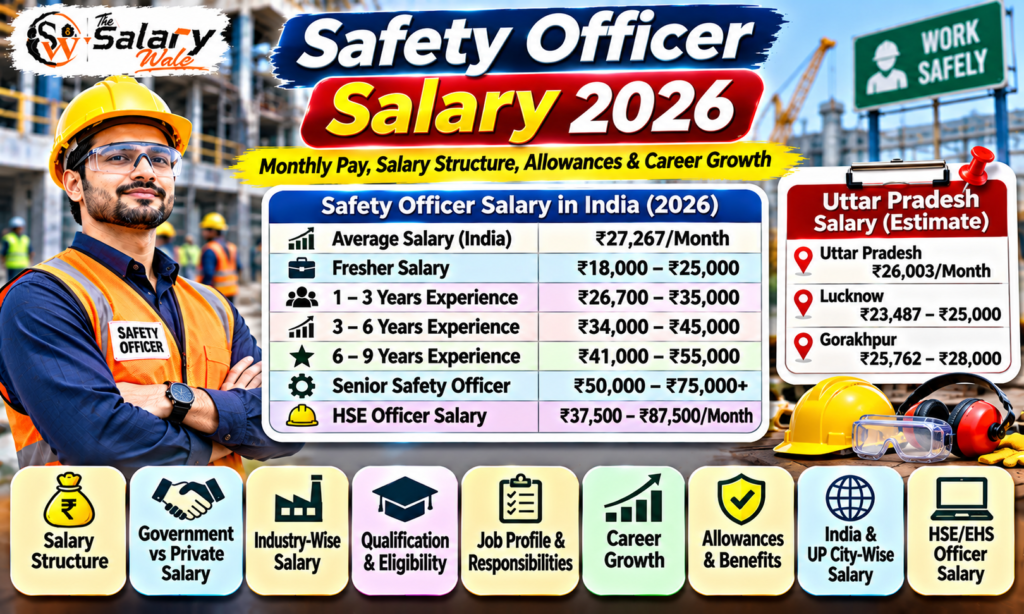
Safety Officer Salary is an important topic for candidates who want to build a career in workplace safety, industrial safety, fire prevention and occupational health. Safety Officers play an essential role in protecting employees, preventing workplace accidents and ensuring that organisations follow applicable safety procedures.
In India, Safety Officers are employed in construction companies, manufacturing units, factories, power plants, oil and gas companies, hospitals, warehouses and infrastructure projects. Their responsibilities include workplace inspections, risk assessments, safety training, accident investigations and monitoring the use of personal protective equipment.
The salary of a Safety Officer depends on experience, educational qualifications, industry, location, employer and job responsibilities. In this guide, we explain Safety Officer Salary in India in 2026, including monthly earnings, government and private-sector pay, fresher salary, Uttar Pradesh salary, job profiles, qualifications and career opportunities.
Safety Officer Salary in India – Quick Overview
A Safety Officer in India may earn different amounts depending on the organisation and experience. Salary portals report different averages because they use different employee submissions, job advertisements and calculation methods.
Indeed reported an average base salary of ₹27,267 per month in India, based on 112 reported salaries, updated on 6 February 2026. Other salary portals publish different estimates based on experience and annual compensation.
| Salary Details | Estimated Amount |
| Average Safety Officer Salary in India | ₹27,267 per month |
| Fresher Safety Officer Salary | ₹18,000–₹25,000 per month |
| 1–3 Years Experience | ₹26,700–₹35,000 per month |
| 3–6 Years Experience | ₹34,000–₹45,000 per month |
| 6–9 Years Experience | ₹41,000–₹55,000 per month |
| Senior Safety Officer | ₹50,000–₹75,000+ per month |
| HSE Officer | Depends on experience and industry |
| Government Safety Officer | As per applicable recruitment pay scale |
| Private Safety Officer | Depends on employer and job location |
Safety Officer Salary Per Month in India
The monthly salary of a Safety Officer depends on the employer, industry, experience and qualifications. Freshers generally begin with entry-level positions, while experienced professionals may receive higher compensation for managing site safety, supervising teams and handling compliance responsibilities.
According to Indeed, the average base salary for a Safety Officer in India was ₹27,267 per month in February 2026. The reported range was approximately ₹15,455 to ₹48,106 per month.
| Salary Category | Monthly Salary |
| Entry-Level Safety Officer | ₹18,000–₹25,000 |
| Junior Safety Officer | ₹22,000–₹32,000 |
| Experienced Safety Officer | ₹30,000–₹45,000 |
| Senior Safety Officer | ₹45,000–₹65,000 |
| HSE Officer | ₹35,000–₹75,000+ |
| Safety Manager | Depends on company and experience |
Safety Officer Salary Based on Experience
Experience is one of the most important factors affecting Safety Officer Salary. Employers generally prefer candidates who understand workplace hazards, safety regulations, risk assessment, emergency procedures and accident prevention.
The following table converts selected annual salary estimates published by NIFS using AmbitionBox and PayScale data into approximate monthly amounts.
| Experience | Annual Salary Estimate | Approx. Monthly Amount |
| Less than 1 Year | ₹2.60 lakh | ₹21,700 |
| 1–3 Years | ₹3.20–₹3.50 lakh | ₹26,700–₹29,200 |
| 1–4 Years | ₹4.00 lakh | ₹33,400 |
| 3–6 Years | ₹4.10–₹4.50 lakh | ₹34,200–₹37,500 |
| 6–9 Years | ₹5.00–₹5.60 lakh | ₹41,700–₹46,700 |
| 9–12 Years | ₹5.80–₹6.40 lakh | ₹48,300–₹53,300 |
Safety Officer Salary for Freshers
Freshers entering the safety profession usually start as Junior Safety Officers, Safety Assistants, Site Safety Officers or Trainee Safety Officers.
The starting salary depends on the candidate’s educational background, safety qualification, practical training and employer. Candidates with relevant industrial exposure or site experience may find better opportunities than applicants with only classroom knowledge.
| Fresher Job Position | Estimated Monthly Salary |
| Safety Trainee | ₹12,000–₹18,000 |
| Safety Assistant | ₹15,000–₹22,000 |
| Junior Safety Officer | ₹18,000–₹25,000 |
| Site Safety Officer | ₹20,000–₹28,000 |
| Fire and Safety Officer | ₹18,000–₹27,000 |
How Can Freshers Get a Better Starting Salary?
Candidates can improve their employment prospects by developing practical knowledge in:
- Workplace hazard identification
- Risk assessment and control measures
- Fire prevention and emergency response
- First aid and basic emergency procedures
- Personal protective equipment (PPE)
- Safety inspections and reporting
- Toolbox talks and worker training
- Accident and near-miss reporting
- Basic safety documentation
Government Safety Officer Salary
Government-sector Safety Officer positions may be available in factories, public-sector undertakings, infrastructure organisations, industrial departments, ports, power projects and other public institutions.
However, there is no single central government salary scale that applies to every Safety Officer in India. The salary depends on the recruiting department, post classification, pay level, state rules and appointment type.
Government Safety Officer Salary Structure
A regular government appointment may provide a structured pay scale and admissible allowances. Some public-sector organisations also offer their own salary structures.
| Government Job Category | Salary Structure |
| State Government Safety Officer | As per state recruitment pay rules |
| Factory Safety Officer | As per department and applicable service rules |
| PSU Safety Officer | As per the organisation’s pay structure |
| Government Project Safety Officer | Depends on recruitment terms |
| Contractual Safety Officer | Fixed remuneration as mentioned in the advertisement |
| Fire and Safety Department Role | Depends on the specific post |
Government vs Contractual Safety Officer
Government employment does not always mean permanent employment. Some departments and public projects recruit Safety Officers on a contractual or project basis.
| Feature | Regular Government Job | Contractual Job |
| Salary | Structured pay scale | Fixed consolidated amount or contract pay |
| Allowances | As admissible under service rules | Only if specified in the contract |
| Job Security | Generally higher | Limited by contract conditions |
| Promotion | Depends on service rules | May not have a regular promotion structure |
| Retirement Benefits | As per applicable scheme | Depends on contract and applicable rules |
Private Safety Officer Salary
Private companies are among the major employers of Safety Officers in India. Construction firms, manufacturing plants, engineering companies, warehouses and industrial facilities regularly require safety professionals. Under Section 40B of the Factories Act, 1948, factories employing 1,000 or more workers—or those carrying out hazardous manufacturing processes—are statutorily required to appoint qualified Safety Officers, ensuring consistent private-sector demand.
Private-sector salary depends on the size of the organisation, project budget, industry risk level, candidate’s experience and responsibilities.
| Private Job Position | Estimated Monthly Salary |
| Safety Assistant | ₹15,000–₹22,000 |
| Junior Safety Officer | ₹18,000–₹28,000 |
| Safety Officer | ₹22,000–₹40,000 |
| Senior Safety Officer | ₹40,000–₹60,000 |
| HSE Officer | ₹35,000–₹75,000 |
| Safety Supervisor | ₹25,000–₹45,000 |
| Safety Manager | ₹60,000–₹1,00,000+ |
Government vs Private Safety Officer Salary
Government and private-sector Safety Officer jobs differ in their salary structures, benefits, recruitment procedures and employment conditions.
| Comparison | Government Job | Private Job |
| Salary Structure | Department pay rules | Company salary policy |
| Recruitment | Official recruitment process | Company selection process |
| Allowances | As per applicable rules | Depends on employer |
| Job Security | Generally higher in regular posts | Depends on employment terms |
| Promotion | Service rules and vacancies | Performance and company policy |
| Working Location | Government facilities and projects | Factories, sites and offices |
| Retirement Benefits | Applicable government scheme | Depends on employer and scheme |
Safety Officer Salary in Uttar Pradesh
Uttar Pradesh has employment opportunities for Safety Officers in construction, manufacturing, infrastructure, power, engineering and industrial organisations.
According to Indeed, the average base salary for a Safety Officer in Uttar Pradesh was ₹26,003 per month, updated on 2 January 2026. However, this figure was based on only four reported salaries, so it should be treated as a limited sample rather than a definitive statewide average.
| Salary Detail | Amount |
| Indeed Average Monthly Salary | ₹26,003 |
| Lower Reported Estimate | ₹17,565 |
| Upper Reported Estimate | ₹38,493 |
| Renukoot Estimate | ₹45,362 |
| Allahabad Estimate | ₹31,607 |
| Noida Estimate | ₹28,933 |
| Greater Noida Estimate | ₹28,694 |
| Lucknow Estimate | ₹23,487 |
Safety Officer Salary in Lucknow
Lucknow offers Safety Officer opportunities in construction projects, hospitals, engineering organisations, manufacturing facilities and infrastructure-related businesses.
Indeed’s Lucknow salary page reported an average of ₹23,487 per month, based on three reported salaries and updated on 18 March 2024. Since this is older and based on a very small sample, it should not be presented as a reliable 2026 average.
A separate Glassdoor salary page displayed an average base pay of approximately ₹25,000 per month, with a commonly shown base-pay range of ₹20,000–₹40,000 per month. These estimates are based on a different platform and methodology.
| Salary Source | Monthly Salary Estimate |
| Indeed (Updated March 2024) | ₹23,487 |
| Glassdoor (Displayed Estimate) | ₹25,000 average base pay |
| Glassdoor Displayed Base Range | ₹20,000–₹40,000 |
Safety Officer Salary in Gorakhpur
Gorakhpur has employment opportunities related to construction, infrastructure, industrial services, hospitals and engineering projects.
Indeed displays an estimated Safety Officer salary of ₹25,762 per month for Gorakhpur. However, its page also shows a problematic salary count and an outdated update date of 31 December 1969. Therefore, this figure should be treated as an unreliable portal estimate rather than a confirmed Gorakhpur average.
A separate Glassdoor page displays a median total-pay estimate of approximately ₹28,000 per month, with a base-pay range of ₹20,000–₹35,000. This is also a platform estimate and should be interpreted cautiously.
| Salary Source | Monthly Salary Estimate |
| Indeed Displayed Estimate | ₹25,762 |
| Glassdoor Displayed Median Total Pay | ₹28,000 |
| Glassdoor Displayed Base Range | ₹20,000–₹35,000 |
Safety Officer Salary in Different Indian Cities
Salary differences across cities are influenced by industrial activity, construction projects, company size, local demand and the availability of qualified professionals.
Indeed’s reported estimates for selected locations include:
| City | Average Monthly Salary Estimate |
| Hyderabad | ₹29,358 |
| Vapi | ₹29,009 |
| Bengaluru | ₹28,580 |
| Noida | ₹28,933 |
| Greater Noida | ₹28,694 |
| Allahabad | ₹31,607 |
| Lucknow | ₹23,487 |
Safety Officer Salary Based on Industry
The industry in which a Safety Officer works can have a major impact on salary. Some sectors involve complex machinery, hazardous materials, heavy equipment, large workforces or high-risk operations, which can require more specialised safety knowledge.
| Industry | Estimated Monthly Salary |
| Construction | ₹22,000–₹40,000 |
| Manufacturing | ₹22,000–₹42,000 |
| Power Plants | ₹25,000–₹50,000 |
| Oil and Gas | ₹35,000–₹70,000+ |
| Engineering Projects | ₹25,000–₹45,000 |
| Warehousing and Logistics | ₹20,000–₹35,000 |
| Hospitals and Healthcare | ₹20,000–₹35,000 |
| Chemical and Process Industries | ₹28,000–₹55,000 |
| Infrastructure Projects | ₹25,000–₹50,000 |
Safety Officer Salary Based on Qualification
Educational qualifications and professional safety training influence the types of positions a candidate can apply for. However, the salary also depends on whether the qualification meets the employer’s requirements and applicable legal rules.
| Qualification | Possible Career Level | Indicative Monthly Salary |
| 12th + Relevant Entry-Level Training | Safety Assistant, Trainee | ₹12,000–₹18,000 |
| Diploma in Fire and Safety | Junior Safety Roles | ₹15,000–₹25,000 |
| Graduation + Safety Diploma | Safety Officer | ₹20,000–₹35,000 |
| Engineering Degree + Safety Qualification | Site or Industrial Safety Roles | ₹25,000–₹45,000 |
| ADIS/PDIS/DIS, where recognised and applicable | Qualified Safety Roles | Depends on employer and eligibility |
| NEBOSH Qualification | HSE and Internationally Oriented Roles | Depends on experience and employer |
HSE Officer and EHS Officer Salary in India
Safety Officers may also work under titles such as HSE Officer, EHS Officer, Health and Safety Officer and Environmental Health and Safety Officer.
Although these titles are related, job responsibilities can differ. HSE usually refers to Health, Safety and Environment, while EHS refers to Environment, Health and Safety.
According to the NIFS salary guide, AmbitionBox-based estimates for HSE Officers vary with experience.
| HSE Officer Experience | Annual Salary Estimate | Approx. Monthly Amount |
| 1–3 Years | ₹4.50–₹5.00 lakh | ₹37,500–₹41,700 |
| 3–6 Years | ₹5.80–₹6.40 lakh | ₹48,300–₹53,300 |
| 6–9 Years | ₹7.90–₹8.80 lakh | ₹65,800–₹73,300 |
| 9–12 Years | ₹9.50–₹10.50 lakh | ₹79,200–₹87,500 |
Safety Officer Salary Structure – Basic, Gross and In-Hand Salary
Understanding the salary structure is important when comparing two job offers. A company may advertise an annual CTC, while another may quote a monthly gross salary or fixed in-hand amount.
Basic Salary
Basic salary is the fixed core component of an employee’s salary. It may be used to calculate certain allowances and statutory contributions, depending on the applicable salary structure.
Gross Salary
Gross salary is the total salary before employee-side deductions. It may include:
- Basic salary
- House Rent Allowance (HRA)
- Special allowance
- Conveyance or transport allowance
- Other applicable components
CTC (Cost to Company)
CTC represents the overall annual cost an employer incurs for an employee. Depending on the organisation’s structure, it may include employer contributions and benefits in addition to monthly salary.
CTC should not be treated as the amount credited to the employee’s bank account.
In-Hand Salary
In-hand salary is the amount an employee receives after applicable deductions.
Possible deductions include:
- Employee Provident Fund (EPF), where applicable
- Employee State Insurance (ESI), where applicable
- Professional tax, where applicable
- Income tax, where applicable
- Other authorised deductions
Example of Safety Officer Salary Calculation
The following is a hypothetical private-sector example to explain the difference between gross and in-hand salary.
| Salary Component | Monthly Amount |
| Basic Salary | ₹15,000 |
| HRA | ₹6,000 |
| Special Allowance | ₹4,000 |
| Other Allowance | ₹2,000 |
| Gross Monthly Salary | ₹27,000 |
| Illustrative Employee Deductions | ₹1,800 |
| Illustrative In-Hand Salary | ₹25,200 |
Allowances and Benefits for Safety Officers
Some employers provide additional benefits along with fixed monthly salary. These benefits are more common in larger organisations, industrial projects and certain field-based positions.
| Allowance or Benefit | Description |
| House Rent Allowance | May be provided as part of salary |
| Travel Allowance | May cover approved work-related travel |
| Site Allowance | May be offered for specific project locations |
| Food Allowance | Depends on employer policy |
| Accommodation | May be provided at selected project sites |
| Medical Insurance | Available according to company policy |
| Provident Fund | Subject to applicable EPF rules |
| Overtime | Pay or compensatory arrangements depend on applicable law and policy |
| Performance Bonus | May be offered under company incentive schemes |
| Paid Leave | As per employment terms and applicable law |
Safety Officer Job Profile and Responsibilities
A Safety Officer helps an organisation maintain a safe working environment and reduce the risk of workplace accidents. The exact duties depend on the industry, project and employer.
Main Responsibilities
- Workplace Safety Inspection Safety Officers inspect factories, construction sites, machinery, work areas and equipment to identify unsafe conditions.
- Risk Assessment They help identify workplace hazards and evaluate the likelihood and potential consequences of accidents.
- Safety Training They conduct safety awareness sessions, toolbox talks and training programmes for employees and workers.
- Personal Protective Equipment Monitoring They check whether workers are using the required PPE, such as helmets, safety shoes, gloves, goggles and protective clothing.
- Accident Investigation When an accident or near miss occurs, they help document the incident, identify contributing factors and recommend preventive measures.
- Fire and Emergency Preparedness They monitor fire safety arrangements, emergency exits, evacuation procedures and emergency response plans.
- Safety Documentation They maintain inspection records, incident reports, training records, risk assessments and other required safety documents.
- Compliance Monitoring They help the organisation follow applicable workplace safety laws, rules, standards and internal procedures.
Safety Officer Eligibility and Qualification
The educational requirements for Safety Officer positions vary by industry, employer and applicable law. Some jobs accept candidates with a diploma or degree in a relevant field, while statutory roles under the Factories Act, 1948 require specific technical degrees/diplomas along with industrial safety qualifications recognised by state governments or central bodies such as DGFASLI (Directorate General Factory Advice Service and Labour Institutes).
| Eligibility Factor | General Requirement |
| Educational Qualification | Relevant diploma or degree, depending on the vacancy |
| Safety Qualification | Industrial safety or fire and safety qualification, where required |
| Technical Knowledge | Workplace hazards, PPE and safety procedures |
| Experience | Fresher or experienced, depending on the post |
| Communication Skills | Ability to explain safety procedures |
| Documentation Skills | Inspection reports and safety records |
| Computer Skills | Basic office and reporting software knowledge |
Safety Officer Course and Certifications
Candidates can consider different safety-related courses depending on their educational background and career goals.
- Diploma in Industrial Safety Industrial Safety diplomas focus on workplace hazards, industrial processes, accident prevention, safety management and relevant safety practices.
- ADIS, PDIS and DIS Advanced Diploma in Industrial Safety (ADIS), Post Diploma in Industrial Safety (PDIS) and Diploma in Industrial Safety (DIS) are qualifications offered through different institutions and systems, including Regional Labour Institutes (RLIs) / Central Labour Institute (CLI) under DGFASLI and state technical education boards. Recognition and eligibility depend on the awarding institution, state rules and the specific Safety Officer post. Candidates should verify whether a particular qualification is accepted for the vacancy they want to apply for.
- NEBOSH NEBOSH qualifications are recognised in many international occupational health and safety environments. They may help candidates develop knowledge of workplace risk management and health and safety systems. A NEBOSH certificate does not automatically replace statutory qualifications required under Indian laws for every Safety Officer appointment.
- IOSH IOSH training programmes provide occupational safety and health learning for different professional levels. Employers may consider such training useful, but acceptance depends on the job requirements.
- Fire and Safety Training Fire and safety programmes may cover fire prevention, emergency response, evacuation procedures, fire equipment and basic safety practices.
How to Become a Safety Officer in India
Candidates interested in becoming Safety Officers can follow these general steps:
- Complete the educational qualification required for the target role.
- Choose a relevant safety or industrial safety course.
- Verify whether the course and institution are recognised for the intended job.
- Develop knowledge of workplace hazards, fire safety and risk assessment.
- Gain practical experience through internships, training or entry-level employment.
- Prepare a professional resume highlighting relevant qualifications and practical skills.
- Apply for vacancies in construction, manufacturing, engineering and other industries.
- Attend interviews and demonstrate practical safety knowledge.
- Continue learning about applicable safety laws, standards and workplace procedures.
Safety Officer Career Growth and Promotion
A Safety Officer can progress to senior safety and management positions with experience, relevant qualifications and leadership skills.
Career progression is not automatic. Promotion depends on the employer’s structure, performance, vacancies and professional requirements.
| Career Stage | Possible Job Position |
| Entry Level | Safety Trainee |
| Junior Level | Safety Assistant |
| Early Career | Junior Safety Officer |
| Experienced | Safety Officer |
| Senior Level | Senior Safety Officer |
| Management Level | HSE Officer or HSE Supervisor |
| Higher Management | HSE Manager |
| Leadership | Head of Safety / HSE Head |
Factors Affecting Safety Officer Salary
Several factors determine how much a Safety Officer can earn in India.
- Work Experience Experienced professionals may be offered higher salaries because they can manage inspections, safety systems, incident investigations and teams.
- Educational Qualification Relevant engineering, science and industrial safety qualifications may help candidates qualify for more specialised roles.
- Industry Oil and gas, power, chemical processing and large infrastructure projects may require specialised safety knowledge and experience.
- Job Location Salary offers can differ between metro cities, industrial areas, project sites and smaller towns.
- Company Size Large organisations may offer more structured compensation packages and additional benefits compared with smaller employers.
- Professional Certifications Relevant certifications can strengthen a candidate’s profile when they match the employer’s requirements.
- Job Responsibilities A professional responsible for a large project, multiple work locations or a safety team may receive higher compensation than someone handling basic site-level duties.
Safety Officer Jobs and Employment Opportunities
Safety Officers can find employment across different industries because workplace safety is relevant to many types of organisations.
| Industry | Possible Employers |
| Construction | Infrastructure and construction companies |
| Manufacturing | Factories and industrial plants |
| Power | Power generation and electrical projects |
| Oil and Gas | Refineries and energy companies |
| Chemical Industry | Chemical and process plants |
| Healthcare | Hospitals and healthcare facilities |
| Warehousing | Logistics and distribution centres |
| Engineering | EPC and engineering companies |
| Mining | Mining and mineral processing organisations |
| Real Estate | Commercial and residential project developers |
Safety Officer Salary in India vs Abroad
Safety professionals may find opportunities outside India, especially in construction, oil and gas, infrastructure, manufacturing and industrial projects.
However, overseas salaries depend on the country, employer, experience, visa status, qualifications and project conditions. A higher foreign salary does not automatically mean higher savings because accommodation, transport, insurance, taxes and living expenses can also be significant.
| Region | Salary Information |
| India | Depends on experience, industry and city |
| Gulf Countries | Depends on country, project and employer |
| United Arab Emirates | Depends on sector and experience |
| Saudi Arabia | Depends on employer and project conditions |
| Qatar | Depends on industry and employment contract |
| Other International Markets | Depends on local regulations and qualifications |
Frequently Asked Questions
What is the average Safety Officer Salary in India?
Indeed reported an average base salary of ₹27,267 per month in India, based on 112 reported salaries updated on 6 February 2026.
What is the starting salary of a Safety Officer in India?
Freshers may receive approximately ₹18,000–₹25,000 per month in some entry-level private-sector positions. The actual amount depends on qualifications, location and employer.
What is the Safety Officer Salary per month?
The monthly salary varies widely. Indeed’s national average was ₹27,267, while experienced professionals may earn more depending on their role and industry.
What is the Safety Officer Salary in Uttar Pradesh?
Indeed reported an average of ₹26,003 per month for Uttar Pradesh, based on four reported salaries updated on 2 January 2026. This is a limited sample and should be treated cautiously.
What is the Safety Officer Salary in Lucknow?
Indeed’s Lucknow estimate was ₹23,487 per month, based on three reported salaries updated in March 2024. A separate Glassdoor estimate displayed approximately ₹25,000 average base pay. These figures have different dates and methodologies.
What is the Safety Officer Salary in Gorakhpur?
Indeed displays an estimated ₹25,762 per month, but its page contains a data-quality issue. Glassdoor displays a median total-pay estimate of approximately ₹28,000 per month. Neither figure should be treated as a guaranteed local average.
Can a fresher become a Safety Officer?
Yes, freshers can apply for eligible trainee, assistant and junior safety positions. Some employers require prior site experience or specific qualifications.
Which qualification is best for a Safety Officer?
The best qualification depends on the target job. Industrial safety diplomas (such as ADIS/PDIS recognised by DGFASLI or state technical boards), relevant engineering or science qualifications, and recognised professional training may be useful. Candidates should check the employer’s eligibility requirements.
Final Words
Safety Officer Salary in India depends on experience, qualifications, industry, employer and job location. Freshers can begin their careers in entry-level safety positions, while experienced professionals may progress to Senior Safety Officer, HSE Officer, HSE Supervisor and Safety Manager roles.
Government jobs may offer structured pay and service benefits, whereas private companies provide opportunities across construction, manufacturing, power, engineering and other industries. Candidates who develop practical safety skills and obtain qualifications accepted by their target employers can improve their career opportunities.
Before accepting a job, candidates should compare the basic salary, gross pay, CTC, in-hand amount, working hours, site conditions and additional benefits. A careful comparison will help them choose a suitable Safety Officer career path in 2026.
Also, Read About: BAMS Doctor Salary in India 2026: Government, Private, Monthly Pay & Career Scope